

How Indian Cinema Is Shaping Today’s Traditional Style: Ajrakh Shirt & Dhoti (Mundu)
- Jan 11
- 3 min read

For Malayalis, clothing has always been closely tied to culture, festivals, and cinema. In recent years, one style combination has quietly but confidently made its way into everyday wardrobes — the Ajrakh shirt paired with Dhoti (Mundu).
What’s interesting is how this shift didn’t come from fashion runways, but from movie screens, press meets, and casual celebrity appearances.
Cinema Influence on Kerala’s Dressing Sense
Malayalam audiences have long taken style cues from films. From white shirts and mundu to modern handloom experiments, cinema continues to influence what people feel comfortable wearing in real life.
Today, Ajrakh — with its earthy tones and handcrafted patterns — fits naturally into this evolution. It feels rooted, effortless, and expressive without being loud.
Ajrakh Shirts in Malayalam Cinema
Dileep in Prince and Family
In Prince and Family, Dileep appears in multiple Ajrakh shirt styles, paired effortlessly with mundu. The look feels casual yet grounded, reinforcing how Ajrakh works well for everyday traditional wear.
Actress: Raniya Raanaa
Other Cast: Dhyan Srinivasan

Sarvam Maya – A Contemporary Take
In the recently released Sarvam Maya, starring Nivin Pauly, the Ajrakh shirt–dhoti combination appears again, especially through Aju Varghese’s styling. The film reflects how this attire blends seamlessly into modern storytelling.
Other Cast: Riya Shibu, Preity Mukhundhan, Alphonse Puthren, Priya Prakash Varrier, Vineeth, Althaf Salim

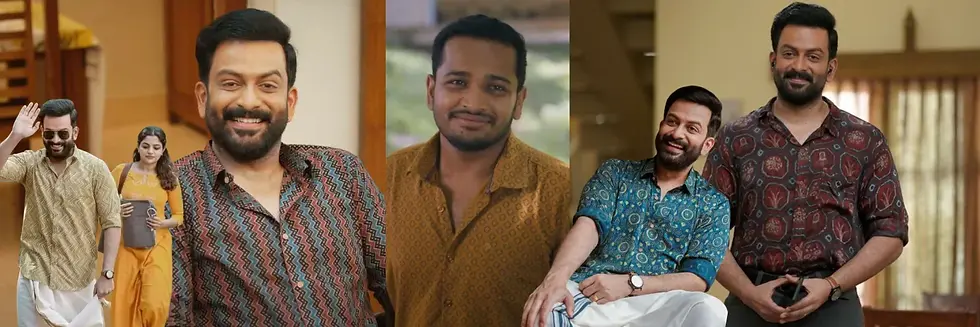
Guruvayoor Ambalanadayil
This film further reinforces the trend, with Prithviraj Sukumaran and Basil Joseph seen wearing traditional-inspired looks that include Ajrakh shirts. The styling feels authentic, festive, and relatable.
Actresses: Anaswara Rajan, Nikhila Vimal
Beyond Movies: Ajrakh in Real Life Appearances
Cinema isn’t the only place Ajrakh is being noticed.
Kunchacko Boban recently attended an interview wearing an Ajrakh shirt, showing how the fabric works even outside film promotions.
Tovino Thomas has been seen wearing Ajrakh shirts both in movies and during media interactions, reinforcing its everyday appeal.
From the Tamil industry, Chiyaan Vikram appeared at a press meet for his upcoming film in an Ajrakh shirt, highlighting the fabric’s pan-Indian acceptance.
In Bengal, Prosenjit Chatterjee, along with Kaushik Ganguly, was spotted on a casual outing wearing an Ajrakh shirt paired with pants — proving Ajrakh’s versatility beyond mundu.

Image references: Kunchacko Boban, Tovino Thomas, Chiyaan Vikram, Prosenjit Chatterjee along with Kaushik Ganguly in Ajrakh shirt
A Pan-Indian Shift Towards Ajrakh
What stands out today is that Ajrakh is no longer limited to one region or one industry. From Malayalam and Tamil cinema to Bengali casual wear, actors across India are choosing Ajrakh — sometimes with dhoti, sometimes with pants — based on comfort, texture, and cultural familiarity.
At the same time, the Dhoti (Mundu) remains a strong companion to Ajrakh, especially in Kerala. Together, they create a look that feels traditional without being ceremonial.
Why This Combination Feels Relevant Today
Rooted in handloom traditions
Comfortable for daily wear
Works across age groups
Adaptable for films, interviews, and casual outings
The Ajrakh shirt and Dhoti combination reflects a larger movement — where people are choosing clothing that feels honest, cultural, and wearable, rather than trend-driven.
Closing Thought
As Indian cinema continues to blur the lines between reel and real life, styles like the Ajrakh shirt with Dhoti naturally find their place in everyday wardrobes. What started as a visual choice on screen has now become a familiar sight across movie industries — and increasingly, in daily life.


Comments